Pages

Monday, May 3, 2010

Scriptural Story-telling


When we lived in Manhattan, we heard mass at St. John the Martyr on East 72nd Street. It is a charming, quaint church between Second and Third Avenues on the Upper East Side. It was a nice two-block walk from where we lived. At the 10:30am Sunday masses, there was this lady who read both First and Second Readings. There wasn’t anything special about her. But it was how she read that made me sit up and listen.

For those who frequently hear mass, on Sundays, at the very least, scripture readings, like the First and Second Readings, are something that you can’t be too really excited about. Sometimes, they’re even hard to understand. Quiz the audience about the readings, and you'll be surprised. Most had a sudden attack of amnesia.

For some, this is the part of the mass where they begin to doze off. Add to this the dry, uninviting, monotone of the more senior members of the parish, whose version of liturgical story-telling seems to become unbearable, and makes the scriptures even more difficult to comprehend and appreciate.

Now, back to the lady at St. John the Martyr…..

She was different. It had been awhile since I last heard someone read the scriptures with such simplicity, clarity, and eloquence. She varied her tone, emphasized key phrases, and delivered with passion. Whenever she read, I would close my eyes and envision her narration. I was like a kid enjoying a wonderful Biblical story as it was being read to me.


People think that being a lector is difficult. It actually isn't, if you do your homework. It's a craft that needs to be mastered. Anyone can read, but not everyone can narrate. Being able to tell a story is very different from reading a text. A lector is a story-teller, someone who gives life to the readings.

As in most undertakings, practice is key. Since scripture readings and mass assignments are known way ahead of time, there is no reason why one should stutter or read like a kindergartener. It’s just inexcusable. But yet it happens. If one cannot spend some time to better their craft, might as well do something else. I think it's an injustice.

A lector's goal is to deliver God’s message, with clarity and conviction, and not bore the community with an incomprehensible recitation. You know that this is achieved when parishioners would come up after mass and say that they enjoyed the readings.

It’s instant gratification like no other. I should know.


(Note: The author is a lector at St. Joseph /Old Mission San Jose Church on 43148 Mission Boulevard, Fremont, CA 94539.)


Monday, March 29, 2010

The Cioppino I Like


Last Saturday, we found ourselves in San Jose – Valley Fair, to be specific. Yes, doing the women’s favorite pastime. After all the walking, sitting, and waiting, we felt the need to replenish our energies. We were starving.

My son, James, was craving for seafood, but said he can eat anything at that point. The pizza place had a 30-minute wait, so that didn’t work. The popular Thai joint around the neighborhood didn’t have parking and people were spilling outside. Obviously, we didn’t even bother to ask how long the wait was. At this point, we were all cranky and hungry.

Then, I remembered the crummy cioppino dish my wife had on her birthday at this San Leandro landmark. That was probably the worst, most expensive cioppino I have ever seen. Not worth the money I paid for. Since I knew she liked it, we decided to go to this place that served every living creature that you can find in the water. Well, almost all.


My wife’s natural choice was their cioppino. I got the same. Our son wanted crabs, but I convinced him that San Francisco had better ones. He settled for good ol’ fish n’ chips. After some time, our server came in with two 12-inch pans of rich, savory goodness. Did I mention it had mussels, clams, scallops, fish, shrimp, oysters, and crabs, simmered in spicy, chunky tomato sauce, topped with parmesan cheese and fresh herbs? To better enjoy the dish, it came with a bib, extra napkin, and wipes in case things got messy.

This cioppino was a far cry from the mediocre imitation my wife had a few weeks back. We were a bit overwhelmed by the serving size. It didn’t seem like we were making any headway. As much as we wanted to continue on, there was just not enough room left. The crab cakes and seafood platter appetizers certainly didn’t help. It was time to raise the white flag. It’s one of those rare dishes I didn’t mind taking home to eat the next day.

It sure was a satisfying and filling evening. And it was a quiet one, too, as my passengers fell in deep slumber as soon as we got on the freeway for the 25-mile drive home.

Author’s Note: Cioppino and other delectable seafood dishes are served at The Fish Market, which is located at 3775 El Camino Real in Santa Clara, and in other locations in the Bay Area.

Tuesday, December 15, 2009

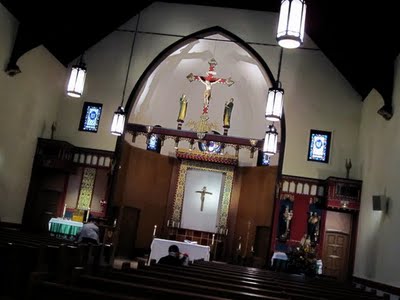
Simbang Gabi @ St. Joe

In a neighborhood on busy Mission Boulevard, off Washington, in Fremont, sits a nondescript one-level structure, next to the historic Old Mission San Jose. It is known as St. Joseph Church, and this is my parish.

St. Joseph is about a 15-minute drive from where me and my family live. Mind you, there are a couple of churches closer to home and a few more within the same driving time. But we continue to go to St. Joseph, as we have done for the last 8 years or so, because there is just something about this community. And this includes the small but growing Filipino population. By the way, my son also goes to St. Joseph School.


Personally, what sets this parish apart from all the others in the area is how nice and closely-knit the people are. You'll be surprised, but the Fil-Ams here are (very) refined. You'll never meet a friendlier, more accommodating, and more welcoming bunch of Pinoys this side of the East Bay. Yes, I am biased, and I am not sorry about it because it is true. Wait till you see the others and you'll know what I mean.

Anyway......

The Filipino community at St. Joseph has been active in the parish for many years. It has participated in numerous parish events and has contributed significantly to the growth of the community. In recent years, the Filipino community began showcasing Philippine culture and liturgical events in this predominantly white parish.

These events include the Feast of the Santo Nino (Feast of the Child Jesus) that is celebrated in January. A major celebration in spring is Flores de Mayo (Flowers of May) and Santacruzan, wherein children offer flowers to the Virgin Mary during Sunday masses throughout the month of May. The festivities culminate with the Santacruzan, a parade of religious characters honoring St. Helena in her search for Jesus' cross.


In September, the feast of the first Filipino saint, Lorenzo Ruiz, is celebrated. Wrapping up the year is Simbang Gabi (Midnight Mass), which is one of the anticipated events of the parish.

Simbang Gabi at St. Joseph is quite unique. It is not just a mass, but a fiesta (feast) of sorts. Unlike the traditional 9-day novena masses at 4:00 in the morning, this Simbang Gabi is a one-day
event, typically, held on the last Saturday before Christmas, and celebrated a little later in the morning, at 6:00 o'clock. And unlike Simbang Gabi back in the Motherland, there are also no puto-bungbong and bibingka (delicacies associated with these dawn masses) sold outside the church courtyard.

But we try to replicate as much as we can, and sometimes, even more. Popular traditional and well-loved contemporary Filipino liturgical songs and Christmas carols fill the nearby Old Mission San Jose church as worshipers brave the chilly, December morning. After the mass, everyone partakes of a sumptuous Filipino breakfast at the Parish Hall. In between bites of daing na bangus, adobo, and sinangag, parishioners are treated to some entertainment that include cultural dances and songs, and performances from talents within the community.

A lot of work goes into the preparation for Simbang Gabi. Music is selected, and the ragtag Filipino Choir does a first pass before a final selection is made. What follow are 5-Friday rehearsals, led by St. Joe's music director, who happens to be white. Meanwhile, a set of volunteers is responsible for promoting the event and securing benefactors to adequately fund the celebration. On the eve of the event, another group of volunteers design, decorate, and set up the Parish Hall for the morning reception. Then, there are those who are responsible for entertainment and ensuring the smooth flow of activities on D-day. After the festivities, everyone pitches in to clean up.

And did I mention about the priest? Well, searching for one, at times, has become an ordeal. Filipino priests are in demand during the holiday season because of the growing number of parishes that celebrate Simbang Gabi that you have to book them way in advance.

Simbang Gabi at St. Joseph is a one-of-a-kind experience. A truly Pinoy event in America.

Partake in the Eucharist, be regaled with the music, savor the fare, and welcome the birth of Jesus Christ.

Come and join the celebration on December 19, 2009, Saturday, 6:00 in the morning, at the Old Mission San Jose church.

By the way, have you ever been to the Old Mission at 6:00 in the morning during winter? It's a BLAST !!!!


Author's Note: The Old Mission San Jose church is located at 43300 Mission Boulevard, Fremont, CA 94539. The Filipino group is called The Filipino Community of St. Joseph/Mission San Jose-TFCSJ, and St. Joseph's music director is Ron McKean.)

Wednesday, October 21, 2009

Games We Used To Play

Whenever we go out with our son, James, he always brings with him a favorite gadget. One day it's a PSP. The next day, it's a Nintendo DS. If he had his way, he would probably be lugging an iTouch, or the new Ipod Nano with video and FM radio. And on long trips, he makes sure we bring along a laptop.

As I look around, I noticed that my son isn't the only one. Other kids around his age do basically the same thing.

They're hunched in one corner, focused on the task at hand, unmindful of the chaos and noise that surrounds them. They see nothing but the play of lights and colors on a glaring screen no bigger than a business card, nor do they hear anyone except the irritating sounds of car crashes, firing spaceships, and karate kicks. For a moment, they're alone in their own world of cyber make believe.

What did I do when I was his age?

Well, for one, we didn't have all these gizmos and contraptions. We had to make do with what we had and what we could find. The games back then were ingenious and creative. And one thing's for sure, we didn't do things alone. We always had someone to play with. Let's stroll down memory lane and see how much of these games do you still remember. I am not even going to attempt to describe the games in detail because some are so convoluted that you'll need a book to talk about it.

Studying in an all-boys school, we played a lot of different games. There was TEX -- a comic card, that was smaller than a credit card, with a number on the bottom right corner. The object was to get as many cards from your opponent as you can, by "betting" a stack of cards (yours) using the numbers on the comic card or by tossing 3 cards in the air. HOLEN (marbles; also called JOLENS) was another popular game. It tested ones finger dexterity and aim, which involved rolling marbles on holes bored on the ground, or by striking
marbles off a circle drawn on the ground.


TURUMPO (top) showed flexibility of the wrist in spinning the wooden top with a long string, while SIPA (meaning "to kick"), made of metal screw washers and shredded plastic strings (called straw) resembling a badminton's shuttlecock, exhibited ones
balance and foot control. Then, there was SIYATO (pronounced as SHATO). This game involved hitting a small stick, about 7-8 inches long, with another stick trice as long, replicating someone pitching a slow softball and while the other batted, minus the diamond, and at a much, much smaller scale.


Growing up, me and my neighbors looked forward to playing street games on weekends. Some of these games are still being played today, not just in the Philippines, but in other parts of the world as well. KICK BALL, an adaptation of baseball, was probably one of the most popular ones, played by both boys and girls. PIKO (hopscotch) and LALANG BALL (dodge ball) are 2 other universal games that we all grew up with. Of course, who can forget TAGUAN (hide and seek).


PATINTERO tested ones speed (and strategy) by not allowing the opponent from crossing the line being guarded. Combining accuracy and speed, TUMBANG PRESO's goal was to knock off

an empty can using a player's slippers, and retrieve the same
slippers without getting caught by the "it." LUKSONG TINIK ("thorn" hurdles) displayed a player's jumping ability, as 2 other kids use their hands and feet to create the hurdle.

Then, there were table games, like DAMA (checkers), using tansan (bottle caps) as game pieces, and SUNGKA (Philippine mancala game). And the favorite games of the girls -- JACKSTONE (both regular and Chinese versions), PICK-UP STICKS, and CHINESE GARTER, to name a few more.

These were the game we used to play. There were others we played growing up, far too many to even mention. These games of my generation were all interactive. Simple and inexpensive as they were, we surely had a great time playing them.

Will our kids ever get a chance to play these games? Maybe. But only if they're available in Wii or Play Station 3.