Pages

Monday, July 29, 2013

My Boy and I

Red
The wife was out on a conference, and James and I were alone for the next few days. Being a lazy Sunday, we didn't have anything much planned. After mass, we grabbed something to eat, then did the groceries. Normally, on weekends, I would go to the Filipino grocery store, Island Pacific, in Union City, to shop for the ingredients I would need to prepare the week's meals. Since it was only the 2 of us, I didn't feel like cooking. It was more practical to either eat out or order food to-go.

Since James was practically at home most days, I also had to think about his lunch. Somehow, this week, he had a craving for pastrami sandwich. And he didn't mind having it everyday -- even twice a day. So number one on our grocery list were 2 pounds of pastrami. He chose his bread and picked his choice of mustard. With a few more essentials in the cart, off we went.

Red 2
Weather was hot, and the temperature inside the house was just a tad cooler. But still hot. Since we had no airconditioning, we had to make do with the ceiling fan in the dining room. We opened the door leading to the backyard so the air could circulate. It helped, but it was still a bit warm.

The night before, I received a message from a friend of mine from back home, whose husband recently had surgery. The husband was a drinking buddy of mine, and both of them were my co-workers some 20-plus years ago. The husband had complications due to diabetes and had to have surgery on his right leg. As much as she didn't want to, the wife sought some financial help because they'd maxed out on their health card coverage. So when we go back from the grocery store, I went online and had money sent to her.

The Social Network
Before dinner, James and I were debating whether or not we should watch a movie. There weren't too many good movies to choose from. Our only choice was Red 2. I suggested that we probably should watch Red (the first one) first so we knew who the characters were and understood the circumstances leading up to Red 2. The first movie wasn't available On Demand (with AT&T u-verse). We tried Red Box, and it wasn't available anywhere either. I guess everyone had the same idea and opted to watch the first movie before screening the second. Without Red, we opted for The Social Network -- the story behind Facebook. It wasn't bad, but it certainly wasn't Oscar material. It was a sleeper, if you'd ask me.

By the time we were done, it was past our bedtime. Off to bed, as Monday was almost upon us.

Saturday, July 27, 2013

Carbon Monoxide Detector Goes Off

Last week, I finally had my HF vertical antenna up and was able to lay 16 ground radials, as best as I could. So far, everything seems to be OK. I have been hearing stations quite well, particularly on 40m (7 MHz) in the evenings. Overall, propagation had been bad from this side of the world, at least, so I'm not as concerned. For the past few days, I've just been scanning the bands and had been listening, but have not made an effort to contact anyone. Hearing stations was one thing. Being heard was another. That would be the ultimate test of my station.

I don't want to bore you with a lot of ham radio terminologies and gobbledegook, so I'll try to keep it at a minimum. And I'll try to make it as simple and as easy to understand as possible.

If you are not familiar, HF (high frequency, typically, below 30.0 MHz) communication uses the atmosphere to "bounce" off signals from one station to the other. The distance between the 2 stations can be in thousands of miles. On a good day, it can be anywhere in the world. For shorter distances, there is what is called a line-of-sight communication for VHF (very high frequency, 30 to 300 MHz) and UHF (ultra high frequency, above 300 MHz). Both VHF & UHF require the 2 contacting stations to "see" each other to establish communication. As a general rule, the lower the frequency, the farther the signal goes.

To help you understand these concepts, just imagine your typical FM and AM radio stations. If you like "old school" music, particularly the 1980s, you'd probably be listening to 98.1 KISS FM. This is an FM station in the SF Bay Area that transmits its signal on 98.1 MHz. If you drive further out of the Bay Area, say head towards Monterey or Carmel, the signal will no longer be as strong. As you drive further out, you may not hear it anymore. And this distance, point to point (not driving distance) is much less than 100 miles. On the other hand, if you listen to KGO 810 on AM, they transmit on 810 KHz (or 0.810 MHz). At the same distance or even further, you can still hear KGO loud and clear. As our general rule goes, the lower the frequency, the farther the signal goes. And goes for 2-way radio communication.

So, why did my carbon monoxide alarm go off? Let me explain....

After dinner last night, I turned my radio on and heard a group of Filipino hams in Washington state and California having a nice roundtable conversation on 40m (7 Mhz). Propagation was pretty good and most of their signals were pretty strong (in other words, LOUD). I decided to join in. I made the necessary adjustments to my equipment, and off I went. I stepped on my foot switch (which triggered my microphone) and blurted out my callsign, "NW6J".

Carbon Monoxide Alarm
I was heard on my first call. Barely into my response back, I heard a high-pitched beeping sound. Crap !!! By keying my microphone (and radio) and with 100 watts of power, I triggered something else in the house. It was an alarm. Probably the smoke alarm. It seemed like the station who acknowledge my call was having some difficulty understanding me. Between him and the beeping sound, I had to cut my conversation abruptly so I can check what was going off.

When I stepped out of the (radio) room (or ham shack, as we would like to call it), the beeping sound stopped. Whew!!! A sigh of relief. Even if the beeping stopped, I knew that it was only temporary, and that it would go off again once I transmitted. I reduced the power on the radio and went back on the air with 50 watts. As soon as I keyed the microphone, the alarm went off again. Holy crap !!! What's going on??? I ran out room, approached the smoke detectors and listened. It wasn't them. Wrong device. The beeping continued. I followed the direction of the beeps, which brought me to the carbon monoxide alarm that was plugged to the wall outlet in the dining room. Bingo!!! I unplugged the alarm and took out the battery. Then it stopped.

I called my son, James, and asked him to observe. I told him to go outside the house, stand by the driveway and see if anything unusual happened to any of our neighbors. I've heard of horror stories about RFI (radio frequency interference), like garage doors opening, lamps turning on/off, and water-sprinklers turning on, to name a few. I also asked James to check if our TV made any buzzing sound or the picture shook or if my voice was coming out of the TV, or if our lights flickered, every time I transmitted. Luckily, it didn't. And so far, nothing from the neighbors either -- at least, not last night.

With the alarm unplugged and the assurance that I have not (yet) cause any disruption to my neighbors and within my own house. I went back on the air and continued with the roundtable conversation. The other stations I was talking to was so kind enough to provide feedback on my audio (how I sounded from their end). After I few adjustment, everything sounded great.

Looking forward to spending more time on the air, and here's hoping that nothing else happens.........to anyone.

Thursday, July 25, 2013

90 Minutes With SEIU-UHW

Another union meeting. Second for this month. And we're, once again, in sunny SCAL. I really hadn't planned on attending this meeting, but our partners on the other side of the negotiation table wanted to talk about wages. So, off I went.

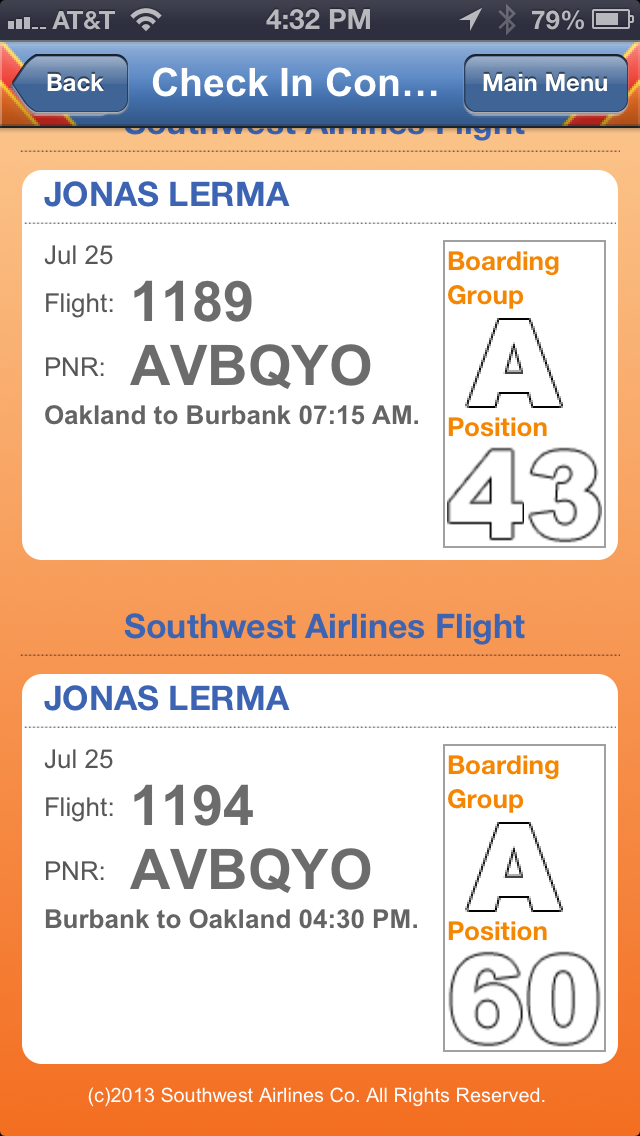
I took the usual Southwest flight that left Oakland airport at 7:10am. This meant I had to be up by 4am, and on BART by 5. I got to the Coliseum station just past 5:30, and after a few minutes, I was on the AirBART shuttle to the airport. Before 6, I was entering Terminal 1, then proceeded to a kiosk to print my boarding pass. Twenty-four hours earlier, I had confirmed my flight via my mobile application, and secured my boarding position.

For an ungodly hour, there was a fairly long line at security screening. But it moved pretty fast so it wasn't an issue. Lots of time to spare. Once cleared, I got coffee and a pastry at a Starbuck's next to my departure gate. It wasn't crowded. I was relaxed. On the same flight with me was our Labor Relations lawyer, Walter, who was a member of our negotiation team.

Walter and I shared a cab to our meeting. On the way, we chatted and shared some experiences about work and our current negotiations. Call time was 9am, but by the time everyone got settled, it was past 10am. Our lead negotiator even arrived late, considering that her office was just a few floors above.

The lead negotiator for the union was a lady named, Veronica. The prior lead wasn't available, so she took over. When the meeting started, it seemed like nobody knew what we were suppose to do or talk about. We went back to the job description and tried to recall what the last discussions were. It revived the whole concern about the driver's license requirement, only to find out that management has struck it out of the final revision of the job description. Aha, we forgot about that. Next?

The other issue centered (again) on the Compliance verbiage. At the last meeting, the union was informed that it was standard language that could not be revised or edited. We gave them a sample, and they were suppose to do their own due diligence. I guess someone forgot to do it, so everyone was scratching their head and looking lost. They then asked for an actual copy of an NCAL union job description so they can confirm. I got a copy sent to me, and it was sent to them.  But, like always, this whole issue was set aside for further discussion and confirmation for the next meeting.

The next topic was about the contractors. Again, both leads looked at each other, as if surprised, and waited for what needed to be discussed. Our lead reminded them that management had already provided a counter-proposal to their proposal, and that the ball was now on their court to respond. Somehow they managed to get away from their predicament by saying that we owed them some information (they earlier requested), and that they could not respond to the counter-proposal without that information. Ergo, another stall, to be discussed in the next meeting, provided we send them the information they asked for.

Another impasse.

Our lead reminded them again that they (the union) specifically requested certain topics to be discussed at the meeting, but it seemed like no one knew or remembered. Even the substitute lead negotiator was not informed nor briefed. Personally, I think that was just plain rude -- to come to a negotiating meeting, with topics you specifically wanted discussed, and not be prepared. So what's new? When we told them that the wages discussion was their idea, they looked stunned and confused. We were expecting them to provide us with a proposal, as a normal process, since they raised it. Immediately, they called for a caucus. It was almost 11am.

They returned from their caucus just past 11:30. In an unusual manner, one of the reps said that they agreed with an earlier pay rate scale I proposed. Management was a little bit surprised and confused because, to our recollection, there wasn't any new or recent proposal from our end, so we didn't really know what they were referencing as "our proposal". We found out that this proposal was made back in February 2012. Holy Toledo !!! The lady lead began rattling off conditions and terms of their proposal as she recalled it from memory. She was interrupted by our lead, and was requested to have their proposal in writing. Another caucus. Since it was close to noon, we all agreed to take a lunch break and resume at 1pm.

The union team departed, while our team remained in the conference room and chatted about this so-called "proposal". Then, we all left and got lunch.

By the time we resumed it was almost 2pm. The union walked us through their proposal, as we tried to visualize them. We said that we will look into this, and that both parties will cost out said proposal for our next round of discussions. We calendared our next meetings for August, again in SCAL. Two back-to-back days were set aside to, hopefully, get resolution and agreement on all pending items. One union rep suggested if management's counter-proposal could just be emailed, instead of meeting in person, but it fell on deaf ears. We adjourned at 2:30pm.

Walter and I took a cab back to the airport. I had called for taxi service during lunch because I had to leave the meeting at 2:45pm to get back to the airport for a 4:30pm flight back to Oakland. Walter had a later flight, but decided to just wait at the airport. He said he would try to get on an earlier flight if he could, which he did. Meanwhile, I sat comfortably at my gate, but was informed that my flight would be delayed by 15 minutes. An earlier flight was leaving at 3:55pm and had room. So I took my chances, and was able to get on the earlier flight -- the same one Walter was on. I was home sooner than expected, which was all good.

Can you imagine? Flying all the way to Pasadena for a 90 minute meeting? How productive and efficient can we be.....???

Tuesday, July 23, 2013

Pack 'Em and Stack 'Em

Our office building management was having work done on all offices. This included repainting of the walls and changing of the carpets. This was an enormous project and schedules were sent out to the tenants at least a month in advance. They briefly described the work that would be done, but didn't provide a whole lot of details. It really didn't matter to us how they'd do it. But what was important was what we needed to do.

Well, we needed to pack our stuff in moving boxes and get out of their way. That was basically it.

This whole packing activity was actually good for me because it allowed me to clean my cube and get rid of all the unnecessary paper and documents that I have accumulated during the past year (yes, maybe more). Anything old or obsolete went straight to the shredding bin. I had a total of 6 boxes, which included one for spare binders and another for old laptop accessories, such as keyboards, batteries, and cords.

There were two activities that needed to be done -- wall painting and carpet changing, spread over two days. On our side of the floor, I believe they've divided the work into 4 sections. For our team, we were divided into 3, just because of how we're physically laid out. My side of the break was for a Tuesday paint and a Wednesday carpet. This meant that I needed to pack all my stuff and be ready by Tuesday, 3:30pm. The rest of our team were divided up into Wednesday-Thursday, and Thursday-Friday.

Frankly, we didn't know how anyone could work on the second day of each schedule if all your stuff were in boxes. For our team, we were instructed to vacate our desks by 3:30pm on the first day, and go home. We would then work from home on the second day, and would return to work the day after. By then, our offices would be ready, and all we needed was to unpack.

I will be in Southern California on Thursday for union negotiations, so I won't be back in the office till Friday. I've heard different comments about the new paint job and carpet, from the other side of the building. I will reserve my comments when I get back.